


Continuity of Seal
In building expansion joints, continuity of seal refers to the assurance of watertight performance throughout the entire length of the joint, including all changes in plane, direction, and intersections, whether within a single joint sealing technology or across multiple technology types. Continuity of seal in most applications is best achieved through the specification, manufacture, and installation of factory-fabricated expansion joint transitions.
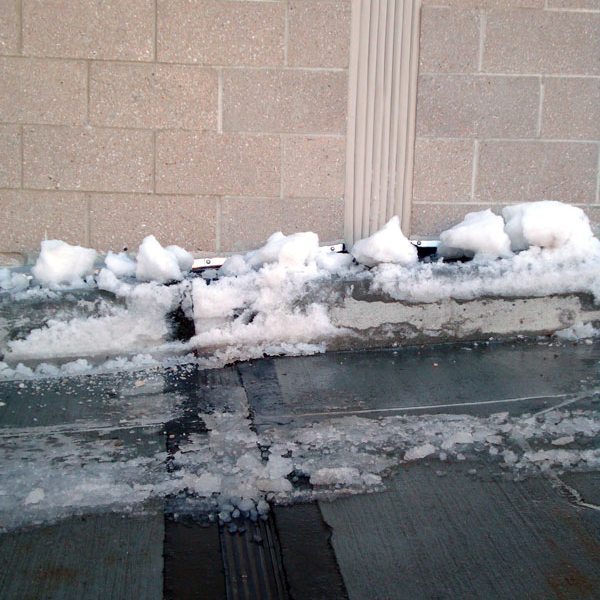
The image above is an excellent example of what we mean by “continuity of seal” in expansion joints. In this condition a Thermaflex parking deck expansion joint crosses a drive lane, transitions up and over a curb, and tees into a perpendicular deck-to-wall joint using our “Shear Pocket” technology. It also intersects with an offset wall joint sealed with Seismic Colorseal, which nests into a “boot termination” that protrudes into the wall and is welded into the Thermaflex system.
Continuity of Seal at Roof-to-Wall Transitions
This often-overlooked detail is one of the most critical connections when transitioning building expansion joints. Sika Emseal addresses complex transitions, such as roof-to-wall intersections, with advanced, factory-fabricated solutions designed to maintain a watertight seal through changes in plane and direction. The RoofJoint system, when integrated with Seismic Colorseal and RoofJoint Wall Closures, provides a robust, watertight connection between roof and wall expansion joints. By eliminating reliance on field-applied caulking or patchwork methods, Sika Emseal’s engineered transitions ensure durability, simplify installation, and reduce the risk of leaks, safeguarding the building envelope against environmental conditions.
NOTE: The definitions of terms and terminology herein are rooted in the context of use in the field of construction-related joint sealing in Sika Emseal’s experience. They are provided with the intent of offering a fuller understanding of the context of their usage. Any suggestions or questions regarding interpretation are welcome and should be directed to [email protected]. Thank you.